Vivaia
Vivaia
Inside VIVAIA’s 654.6% Growth: The Strategy Behind One of the World’s Fastest-Growing DTC Brands
Inside VIVAIA’s 654.6% Growth: The Strategy Behind One of the World’s Fastest-Growing DTC Brands

Introduction
Introduction
In the 2023 “Digital 100” ranking released by SimilarWeb, VIVAIA ranked No.1 in the U.S. apparel and accessories category with an astonishing 654.6% growth rate. The brand’s rapid rise quickly drew widespread attention across the industry. However, VIVAIA’s success was far from accidental. Behind it lies a series of highly efficient and meticulously executed operational strategies.
In the 2023 “Digital 100” ranking released by SimilarWeb, VIVAIA ranked No.1 in the U.S. apparel and accessories category with an astonishing 654.6% growth rate. The brand’s rapid rise quickly drew widespread attention across the industry. However, VIVAIA’s success was far from accidental. Behind it lies a series of highly efficient and meticulously executed operational strategies.

About VIVAIA and Ptengine
About VIVAIA and Ptengine
Founded in June 2020, VIVAIA achieved the fastest global growth rate in the DTC footwear category within just three years. This success stems not only from its cutting-edge design philosophy and strong commitment to sustainability, but also from its distinctive digital operations strategy.
Hollywood stars such as Selena Gomez and Scarlett Johansson have publicly expressed their appreciation for the brand, further accelerating VIVAIA’s rise in both brand strength and global recognition.
In the highly competitive apparel and accessories market, VIVAIA’s remarkable achievements demonstrate the importance of rapid and continuous customer insights driven by data, as well as product supply strategies and digital experience optimization. These factors are particularly critical in an environment where trend cycles are short and customer preferences evolve rapidly.
As a close partner of VIVAIA, Ptengine sought to understand these dynamics more deeply. To explore this further, we interviewed VIVAIA’s co-founder Jeff, who shared his insights and perspectives.
Founded in June 2020, VIVAIA achieved the fastest global growth rate in the DTC footwear category within just three years. This success stems not only from its cutting-edge design philosophy and strong commitment to sustainability, but also from its distinctive digital operations strategy.
Hollywood stars such as Selena Gomez and Scarlett Johansson have publicly expressed their appreciation for the brand, further accelerating VIVAIA’s rise in both brand strength and global recognition.
In the highly competitive apparel and accessories market, VIVAIA’s remarkable achievements demonstrate the importance of rapid and continuous customer insights driven by data, as well as product supply strategies and digital experience optimization. These factors are particularly critical in an environment where trend cycles are short and customer preferences evolve rapidly.
As a close partner of VIVAIA, Ptengine sought to understand these dynamics more deeply. To explore this further, we interviewed VIVAIA’s co-founder Jeff, who shared his insights and perspectives.

The Key Lever Behind VIVAIA’s Independent Site Growth—Landing Page Optimization (LPO)
The Key Lever Behind VIVAIA’s Independent Site Growth—Landing Page Optimization (LPO)
One of the most powerful levers behind the operational efficiency of VIVAIA’s independent website is LPO (Landing Page Optimization).
Interestingly, Ptengine’s partner in the Japanese market, the fitness brand RIZAP Group, whose market capitalization exceeds tens of billions of yen, has also identified data-driven decision-making and scientific validation as the core engine of its growth. This approach has even been formally written into its financial reports as part of its annual strategy.
At the same time, RIZAP plans to create 260 different types of landing pages (LPs), leveraging LPO as a key driver to accelerate business growth even further.
One of the most powerful levers behind the operational efficiency of VIVAIA’s independent website is LPO (Landing Page Optimization).
Interestingly, Ptengine’s partner in the Japanese market, the fitness brand RIZAP Group, whose market capitalization exceeds tens of billions of yen, has also identified data-driven decision-making and scientific validation as the core engine of its growth. This approach has even been formally written into its financial reports as part of its annual strategy.
At the same time, RIZAP plans to create 260 different types of landing pages (LPs), leveraging LPO as a key driver to accelerate business growth even further.
VIVAIA’s landing page optimization includes several key elements.
VIVAIA’s landing page optimization includes several key elements.
Key Aspect 1: Refined Traffic and Landing Page Operations
Key Aspect 1: Refined Traffic and Landing Page Operations
From the very beginning, VIVAIA adopted a “personalized traffic strategy”, segmenting traffic so that each channel could be matched with a tailored landing experience. This refined approach not only helped reduce advertising costs in the early stage but also enabled the brand to build a deeper understanding of audiences from different sources.
For example, imagine five channels: A, B, C, D, and E, where channel A further contains sub-channels such as A1, A2, and A3. Traditionally, companies might use a single landing page to support multiple campaigns. Even if the traffic-side optimization performs well, failing to adjust the corresponding landing page can significantly weaken the overall results.
Audiences differ across channels, and each campaign communicates different messages. While this idea seems straightforward, such refined operational practices are still relatively rare in the DTC industry.
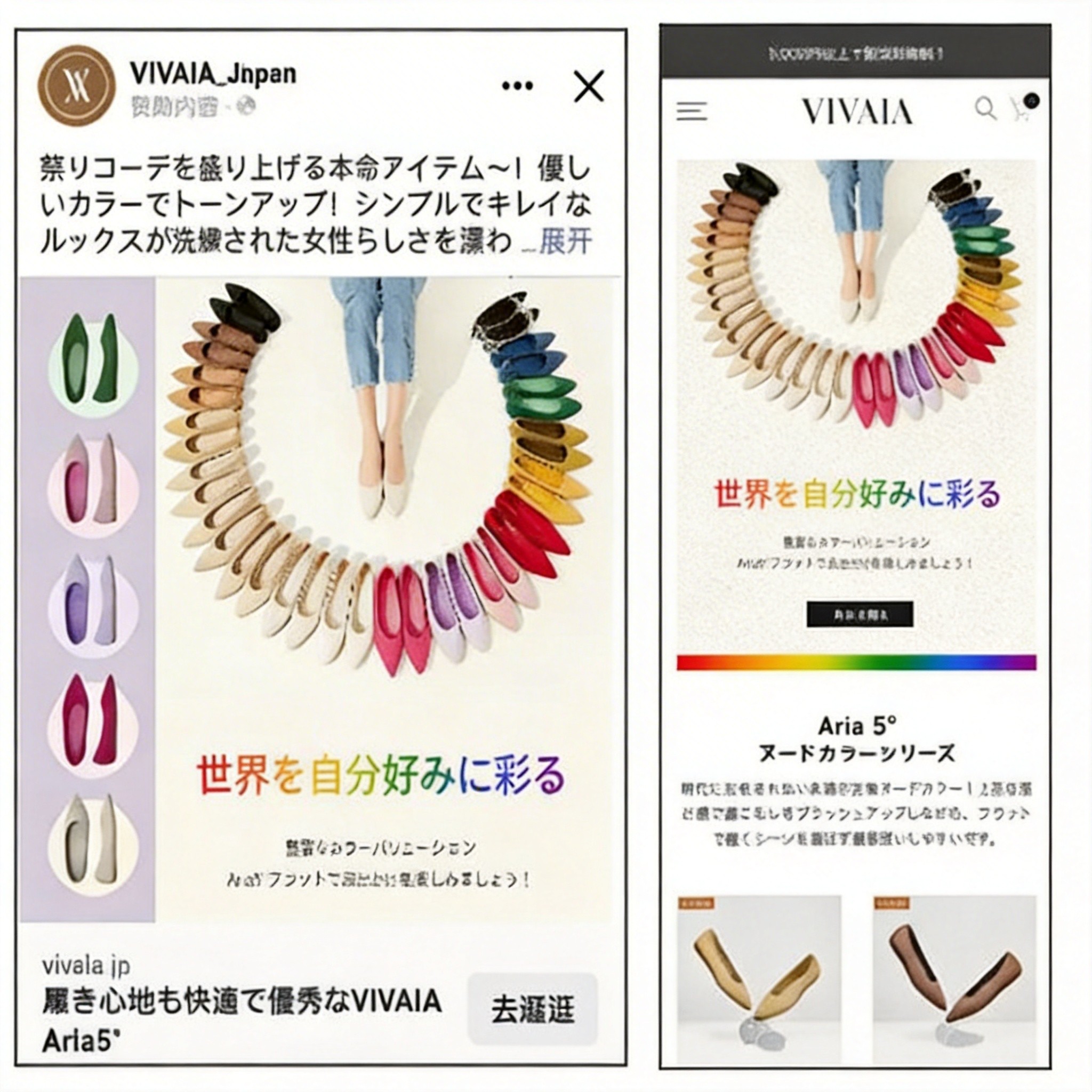
For instance, as shown in the example ad creative, the left image emphasizes color diversity. When users click through to the landing page, the hero banner immediately presents a wide range of colors, maintaining strong consistency with the ad message.
From the very beginning, VIVAIA adopted a “personalized traffic strategy”, segmenting traffic so that each channel could be matched with a tailored landing experience. This refined approach not only helped reduce advertising costs in the early stage but also enabled the brand to build a deeper understanding of audiences from different sources.
For example, imagine five channels: A, B, C, D, and E, where channel A further contains sub-channels such as A1, A2, and A3. Traditionally, companies might use a single landing page to support multiple campaigns. Even if the traffic-side optimization performs well, failing to adjust the corresponding landing page can significantly weaken the overall results.
Audiences differ across channels, and each campaign communicates different messages. While this idea seems straightforward, such refined operational practices are still relatively rare in the DTC industry.
For instance, as shown in the example ad creative, the left image emphasizes color diversity. When users click through to the landing page, the hero banner immediately presents a wide range of colors, maintaining strong consistency with the ad message.
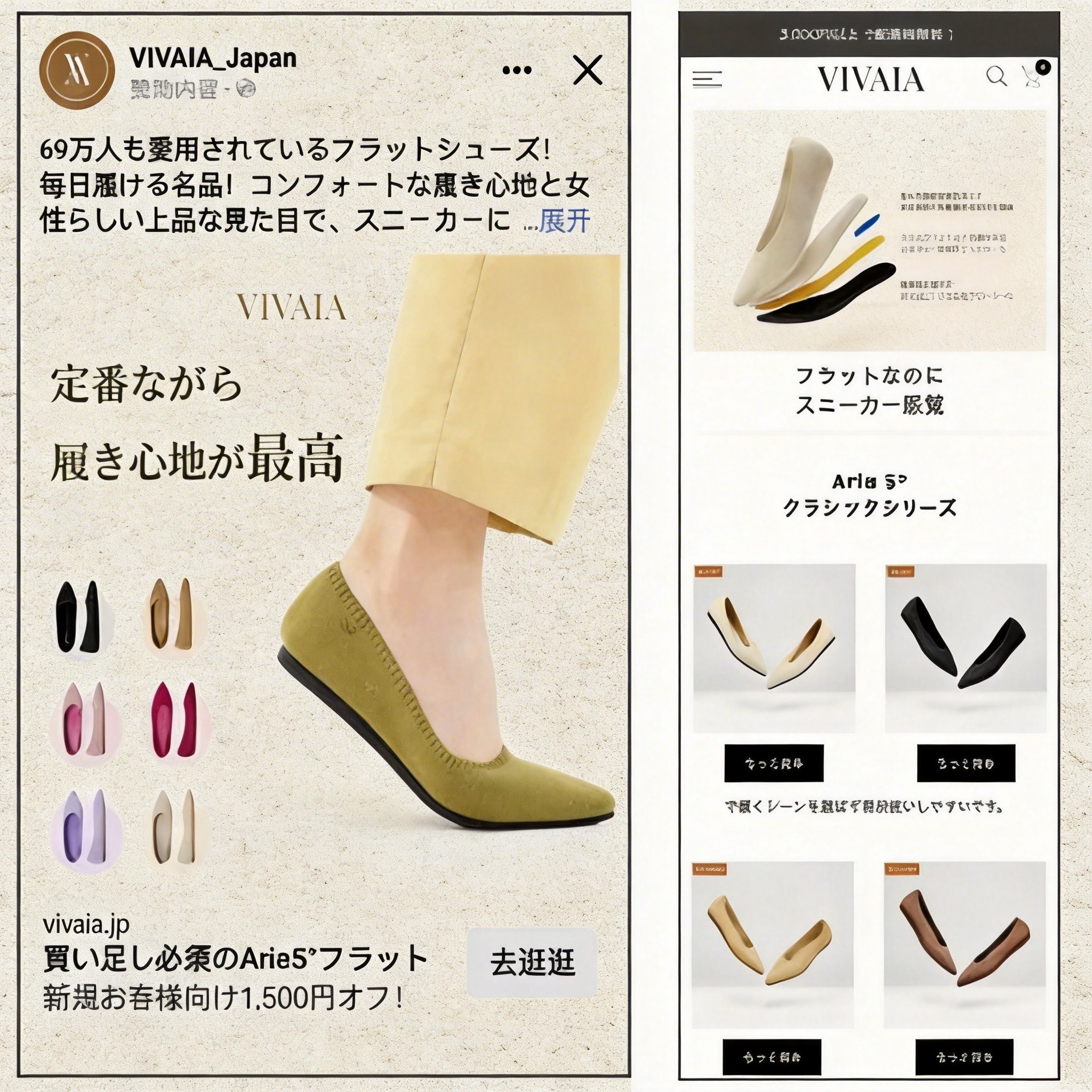
Similarly, the ad creative on the left highlights the product’s comfort. When users land on the page, the hero banner immediately explains why the product is so comfortable, maintaining clear consistency with the ad message.
Similarly, the ad creative on the left highlights the product’s comfort. When users land on the page, the hero banner immediately explains why the product is so comfortable, maintaining clear consistency with the ad message.
The examples above represent just two campaigns from a single traffic source, and there are many more similar cases.
In the initial stage, the goal was to ensure a high level of consistency between ad creatives and landing pages, allowing users to continuously encounter the same messaging they first engaged with, thereby increasing the likelihood of conversion.
At the same time, internal comparison tests showed that conversion rates improved significantly after implementing refined operations. This approach gradually evolved into an internal standard operating procedure (SOP).
In other words, from the moment a campaign is created, all outward-facing content should maintain strong consistency, enabling more precise targeting and engagement with incoming traffic.
The examples above represent just two campaigns from a single traffic source, and there are many more similar cases.
In the initial stage, the goal was to ensure a high level of consistency between ad creatives and landing pages, allowing users to continuously encounter the same messaging they first engaged with, thereby increasing the likelihood of conversion.
At the same time, internal comparison tests showed that conversion rates improved significantly after implementing refined operations. This approach gradually evolved into an internal standard operating procedure (SOP).
In other words, from the moment a campaign is created, all outward-facing content should maintain strong consistency, enabling more precise targeting and engagement with incoming traffic.
Key Aspect 2: Bringing the Brand Closer to Its Users
Key Aspect 2: Bringing the Brand Closer to Its Users
VIVAIA has always placed user experience at the center of its strategy. On its independent website, the brand has conducted over 100 user surveys and collected more than one million pieces of customer feedback.
These insights are not only used for product iteration and marketing communication, but also serve as the source of content creation and are treated internally as P0-level priorities (the highest priority).
For VIVAIA, user experience always comes first. The brand consistently approaches decisions from the user’s perspective, using this mindset to continuously strengthen its brand influence.
Every piece of feedback is regarded as a key driver of business growth. When customer suggestions emerge, the brand gathers all product-related teams to review and discuss them together.
By placing such strong emphasis on user experience, VIVAIA can respond quickly to market changes and continuously improve both its products and services.
However, some brands only emphasize “understanding users” in words without putting it into real practice. Others simply collect feedback but fail to apply customer insights to product iteration or improvements in the shopping experience.
VIVAIA takes a different approach. The brand actively applies research insights to marketing communication, value proposition refinement, audience targeting, and shopping experience optimization.
At the same time, each option selected by users during surveys becomes an interaction tag. This means every survey not only captures users’ explicit responses but also generates implicit behavioral tags, further enriching the brand’s user tagging system and deepening its understanding of customers.
VIVAIA has always placed user experience at the center of its strategy. On its independent website, the brand has conducted over 100 user surveys and collected more than one million pieces of customer feedback.
These insights are not only used for product iteration and marketing communication, but also serve as the source of content creation and are treated internally as P0-level priorities (the highest priority).
For VIVAIA, user experience always comes first. The brand consistently approaches decisions from the user’s perspective, using this mindset to continuously strengthen its brand influence.
Every piece of feedback is regarded as a key driver of business growth. When customer suggestions emerge, the brand gathers all product-related teams to review and discuss them together.
By placing such strong emphasis on user experience, VIVAIA can respond quickly to market changes and continuously improve both its products and services.
However, some brands only emphasize “understanding users” in words without putting it into real practice. Others simply collect feedback but fail to apply customer insights to product iteration or improvements in the shopping experience.
VIVAIA takes a different approach. The brand actively applies research insights to marketing communication, value proposition refinement, audience targeting, and shopping experience optimization.
At the same time, each option selected by users during surveys becomes an interaction tag. This means every survey not only captures users’ explicit responses but also generates implicit behavioral tags, further enriching the brand’s user tagging system and deepening its understanding of customers.

Looking Ahead
Looking Ahead
For companies currently developing DTC businesses, the experience of VIVAIA offers valuable insights to learn from.
In sales, the focus should shift toward communicating a product’s unique value proposition through carefully designed advertising, rather than relying solely on low-price strategies to attract users. By addressing the real needs of target customers and helping them easily find products that match their personalized preferences, brands can move beyond price competition and quickly build core competitiveness. Ultimately, what is being sold is not just a product, but a solution to customer needs.
In marketing, brands should remain committed to data-driven and scientifically validated decision-making, strengthening brand awareness and market positioning through positive and strategic approaches. As core competitiveness grows, consumers can clearly perceive the brand’s unique value even when comparing it with competitors. Once a brand moves beyond price competition, it gains stronger margins, which can then be reinvested into improving products and further reinforcing its position in consumers’ minds.
In brand building, the emphasis should be on creating long-term brand value, allowing customers to feel the brand’s dedication throughout their purchasing journey. By establishing emotional connections with users and continuously improving the user experience, brands can shape a distinctive identity and become the preferred choice for consumers.
Over the past year, VIVAIA conducted nearly 1,000 A/B tests, carried out over 100 user research studies, and collected more than one million pieces of customer feedback, optimizing every piece of content presented to the public. Through refined traffic operations, scientifically validated A/B testing, personalized user services, and a strong commitment to user experience, the brand has continued to grow steadily.
The growth journey of VIVAIA is far from over. We continue moving forward and look forward to partnering with more Chinese brands to expand globally.
For companies currently developing DTC businesses, the experience of VIVAIA offers valuable insights to learn from.
In sales, the focus should shift toward communicating a product’s unique value proposition through carefully designed advertising, rather than relying solely on low-price strategies to attract users. By addressing the real needs of target customers and helping them easily find products that match their personalized preferences, brands can move beyond price competition and quickly build core competitiveness. Ultimately, what is being sold is not just a product, but a solution to customer needs.
In marketing, brands should remain committed to data-driven and scientifically validated decision-making, strengthening brand awareness and market positioning through positive and strategic approaches. As core competitiveness grows, consumers can clearly perceive the brand’s unique value even when comparing it with competitors. Once a brand moves beyond price competition, it gains stronger margins, which can then be reinvested into improving products and further reinforcing its position in consumers’ minds.
In brand building, the emphasis should be on creating long-term brand value, allowing customers to feel the brand’s dedication throughout their purchasing journey. By establishing emotional connections with users and continuously improving the user experience, brands can shape a distinctive identity and become the preferred choice for consumers.
Over the past year, VIVAIA conducted nearly 1,000 A/B tests, carried out over 100 user research studies, and collected more than one million pieces of customer feedback, optimizing every piece of content presented to the public. Through refined traffic operations, scientifically validated A/B testing, personalized user services, and a strong commitment to user experience, the brand has continued to grow steadily.
The growth journey of VIVAIA is far from over. We continue moving forward and look forward to partnering with more Chinese brands to expand globally.